
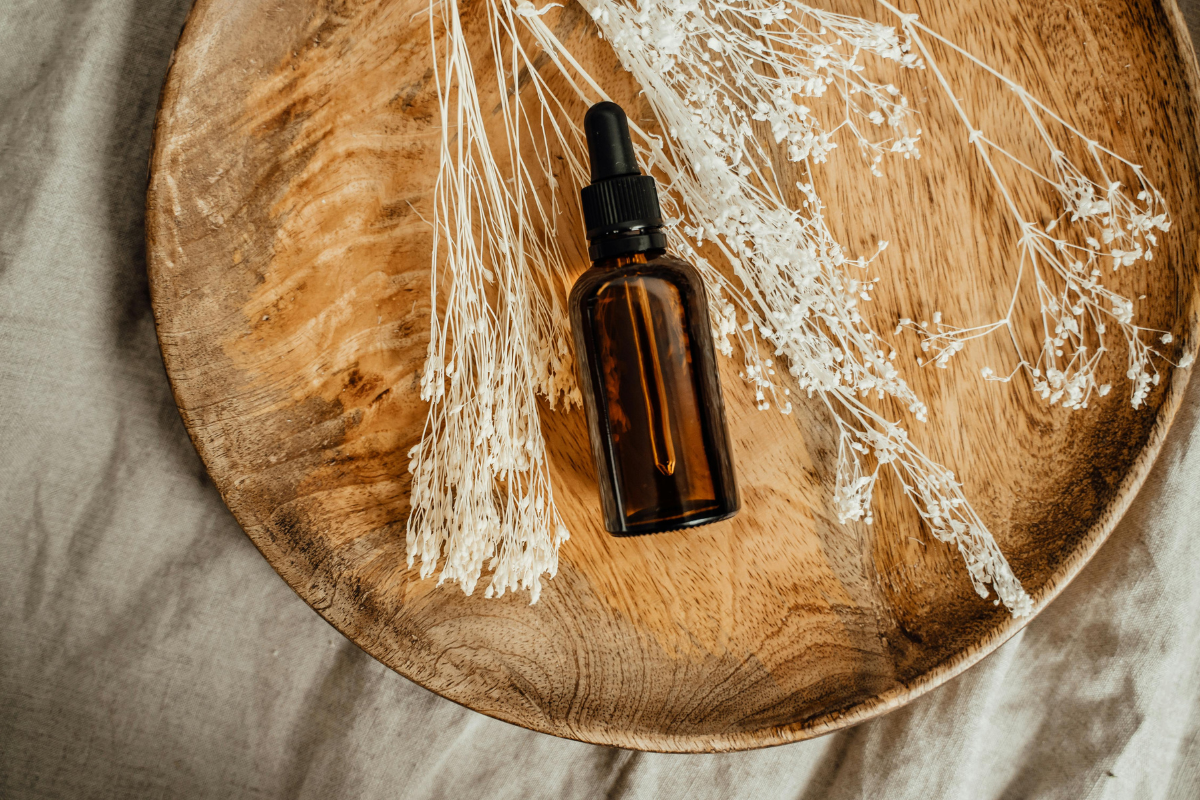
For centuries, aromatic plants have fascinated humanity with their captivating scents and traditional virtues. Today, essential oils are enjoying a real surge of interest in the field of natural wellbeing. Yet behind their gentle, natural image lies a more complex reality that's worth understanding. Let's dive together into this fascinating world to discover what you absolutely need to know before adding them to your everyday life.
What is an essential oil?
Essential oils are far more than just a pleasant scent. In reality, they are extremely concentrated extracts from carefully selected aromatic plants. To obtain these precious liquids, producers use different parts of the plant: the delicate flowers of lavender, the fragrant leaves of mint, the zesty peel of citrus fruits, the noble wood of sandalwood or even the roots. Each part thus reveals its own aromatic treasures.
Two extraction methods largely dominate the sector:
-
On one hand, steam distillation captures the essence of plants by passing steam through the plant material.
-
On the other, cold pressing applies mainly to citrus fruits, whose peel is mechanically pressed to release their precious oils.
These age-old processes, refined over time, guarantee an exceptional concentration of active aromatic molecules.
Are essential oils dangerous?
A very high concentration
What truly sets essential oils apart from other plant extracts is their remarkable concentration. Indeed, a tiny amount contains considerable molecular richness. To illustrate this, just a few drops can contain the equivalent of several hundred grams of plant material. This density explains why they're considered the true 'quintessence' of the plant.
Nonetheless, this impressive potency calls for a thoughtful approach. It's precisely for this reason that aromatherapy experts systematically recommend appropriate dilutions.
Uses that aren't trivial
Depending on the essential oil, the ways of using them vary: skin application, diffusion, inhalation or, more rarely, ingestion. This diversity requires a good knowledge of the uses, because an unsuitable dose or the wrong route of use can cause adverse reactions.
Some oils are indeed irritating to the skin and can cause redness, burns or allergic reactions when used neat or too concentrated. In some cases we speak of 'dermocaustic' oils, because of their aggressive action on tissue.
Sensitivity also varies from person to person. Children, pregnant women, people with asthma or prone to allergies are more sensitive to certain aromatic molecules. A use tolerated by a healthy adult isn't necessarily so in these particular situations.
Finally, some essential oils can interact with medication or be inadvisable with specific conditions. This point is often underestimated, even though it's essential before any use.
Why Danika products are formulated without essential oils
Danika products are formulated without essential oils, as part of an approach focused on tolerance and safe use.
Essential oils are very concentrated substances that require certain precautions and precise dosing. Although they can have their place in certain uses, Danika has chosen to exclude them from its formulas in order to favour a more restrained approach, centred on skin comfort and simplicity.
This choice helps limit repeated exposure to certain aromatic molecules that may cause reactions in the most sensitive people. It also contributes to creating cleaner, more stable formulas that are easy to fit into a daily routine.
10 essential oils to know
1. Roman chamomile essential oil
Roman chamomile is traditionally associated with soothing, skin comfort and relaxation. It's sometimes included in evening routines or moments of relaxation, as part of an approach encouraging a return to calm.
When used as an essential oil, it's applied diluted in a carrier oil or by gentle diffusion. Like any essential oil, its use requires certain precautions, particularly for people with reactive skin or an allergic tendency.
2. Java citronella essential oil
Java citronella is frequently used in aromatic diffusion to create a scented atmosphere in summer.
Because of its strong aromatic profile, it's usually used in the ambient air rather than applied directly to the skin.
3. Eucalyptus radiata essential oil
Eucalyptus radiata is linked to respiratory comfort, particularly in winter or during seasonal discomfort.
When used as an essential oil, it's used by diffusion, indirect inhalation or incorporated into aromatic blends. As with all essential oils, its use requires certain precautions, especially for people who are sensitive, asthmatic or particularly reactive to scented substances.
4. Ginger essential oil
Ginger is traditionally associated with digestive comfort and vitality, particularly in cases of temporary fatigue. Its essential oil is among the so-called 'potent' extracts, because of its high concentration of aromatic compounds.
Its use requires strict dilution and should remain occasional. That's why it's reserved for people familiar with aromatherapy precautions.
5. True lavender essential oil
True lavender is among the most widely used essential oils in wellbeing routines.
It encourages relaxation, preparing for sleep and managing everyday tension. It can be used by diffusion or applied very diluted, depending on individual sensitivities.
6. Tea tree essential oil
Tea tree is associated with skin hygiene routines and targeted care.
It's used in a targeted way, always diluted in a carrier oil, to combat acne, dandruff and skin problems. Its use requires particular attention, especially on sensitive areas and reactive skin.
7. Grapefruit essential oil
Grapefruit is traditionally associated with circulatory comfort and the sensation of heavy legs. It's used in massage, diluted in a carrier oil.
8. Patchouli essential oil
Patchouli is known for its deep scent and its uses in body care.
It's traditionally included in preparations intended for skin or circulatory comfort. It's used diluted, often blended with other carrier or essential oils.
9. Petitgrain bigarade essential oil
Petitgrain bigarade is traditionally associated with moments of relaxation and support during stressful periods.
It's used by diffusion, particularly during phases of emotional tension or nervous fatigue, as part of a logic of refocusing and calming.
10. Peppermint essential oil
Peppermint is a very concentrated essential oil, known for its aromatic intensity.
It helps restore mental clarity and is used during periods of temporary fatigue or a need for greater concentration. Because of its potency, its use should remain controlled, with strict precautions and use suited to people familiar with aromatherapy.
To go further, discover our article: 10 food supplements worth knowing.
FAQ
Are essential oils safe?
They can pose risks if used incorrectly. Their high concentration calls for strict precautions, particularly for children, pregnant women and sensitive people.
Can you apply a neat essential oil to the skin?
In the vast majority of cases, this isn't recommended. Dilution in a carrier oil is generally necessary to limit irritation.
Can essential oils be ingested?
Some practices exist, but they remain tightly controlled and should only be done with qualified professional advice.
How long can you use an essential oil?
Uses are in principle occasional or limited in time. Prolonged use without supervision isn't advisable.
Do essential oils replace medical treatment?
They can accompany a wellbeing approach but never replace treatment or medical advice.
Do all essential oils have the same effects?
Each oil has a specific chemical composition that determines its uses, its limits and its precautions.
Is diffusion risk-free?
It should be moderate, done in a ventilated space and suited to the people present in the room.
How do you choose a quality essential oil?
Quality depends in particular on traceability, the extraction method, purity and the product's storage conditions.
Best Sellers


Livraison gratuite dès 49€

Paiement sécurisé

Envoi rapide

Service client réactif