
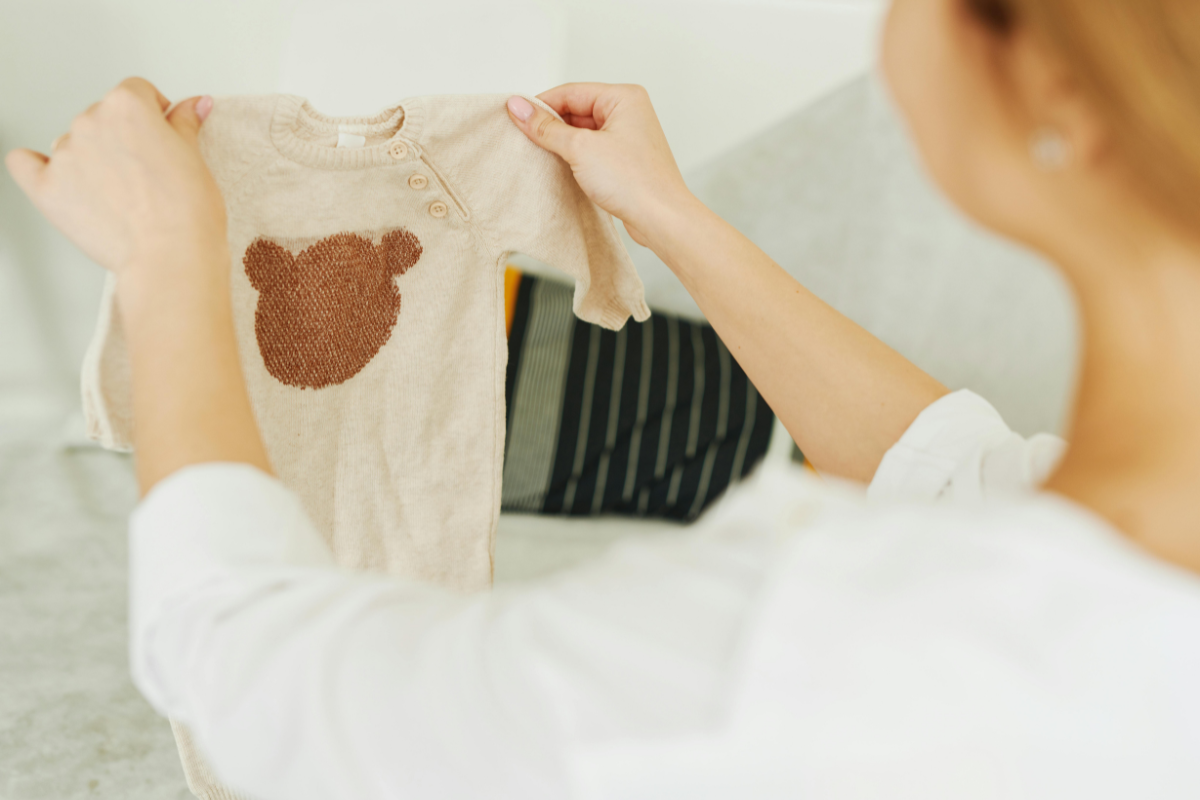
Why is it important to choose a laundry detergent for baby's laundry? How do you choose the most suitable baby detergent? Can I use a conventional detergent for baby's laundry? Which detergent should you choose for baby's laundry? Your child is born or about to be born and you want to know why there are specific baby detergents and, above all, whether it's just marketing. We tell you everything in this article.
Choosing a detergent for baby's laundry: why do babies need a special one?
If baby clothes need a suitable detergent, it isn't so much because of stains as the fragility of their skin. Thinner and more permeable than an adult's, it's more exposed to irritation, redness and itching. This sensitivity is explained in particular by the immaturity of the skin barrier during the first years of life.
Choosing a gentle, suitable detergent therefore helps limit exposure to certain potentially harsh ingredients. A precaution all the more relevant as clothes, sheets and towels are with baby every day.
Are baby detergents just conventional detergents?
It's a legitimate question, because some manufacturers are very good at marketing. They lead you to believe it's a suitable detergent when the formulation has exactly the same composition and the same proportions as their other detergents. Worse, they raise the price when all they've changed is the fragrance.
As you'll have gathered, some “baby detergents” are in fact just conventional detergents repackaged with cuter packaging and a slightly gentler fragrance. Fortunately, some manufacturers do their job very well and offer a certified hypoallergenic detergent, at the same price as their other detergents and genuinely suited to sensitive skin.
Which detergent should you choose for baby's laundry?
To choose a special baby detergent, you need to think about the product's key features.
A baby laundry detergent suited to sensitive skin
For babies' laundry, favour a baby-suitable detergent formulated for sensitive skin. These products are generally designed to limit substances likely to cause skin irritation.
Check for the “hypoallergenic” claim
Not all detergents that are kind to babies' skin are equal. To reduce the risk of skin reactions, favour a certified hypoallergenic formula.
Be careful, however, about the wording on the packaging. A claim like “hypoallergenic fragrance” concerns only the fragrance and not the whole formula. Instead look for a certification covering the detergent as a whole.
Likewise, the phrases “dermatologically tested” or “for sensitive skin” aren't, on their own, a guarantee of safety.
Natural laundry detergent for babies? Opt for a simple composition
The ingredient list is worth a look. A short formula made mostly of ingredients of natural origin is often preferable.
The aim isn't to find a perfect detergent, but to limit superfluous components. A few well-chosen ingredients are enough to clean baby's laundry effectively.
How do you spot a genuine quality baby detergent?
To avoid hollow marketing, here are a few concrete signs:
- The detergent should be certified hypoallergenic by an independent expert.
- The composition should be clear, short and easy to read, with few ingredients.
- The product should be dermatologically tested on sensitive skin.
- The price should be consistent with the brand's other detergents, with no unjustified mark-up.
Finally, the word “hypoallergenic” should apply to the entire product and not just the fragrance.
Liquid or powder laundry detergent for baby's laundry: which should you choose?
The choice between a liquid and a powder detergent depends above all on their formulation. Both formats wash baby's laundry effectively, provided they're suited to sensitive skin and correctly measured out:
- Liquid detergent dissolves quickly, even at low temperature, which makes it practical for everyday washes. On the other hand, it generally contains more preservatives to guarantee its stability over time.
- Powder detergent contains no water and, in principle, fewer preservatives.
Can I use a conventional detergent for baby's laundry?
You can technically use a conventional detergent, but it isn't recommended. Conventional detergents for adults often contain more allergenic synthetic fragrances, dyes, preservatives, bleaching agents and endocrine disruptors.
As baby's skin is 5 times thinner and more permeable, these substances can irritate the skin, cause redness, trigger itching and worsen or encourage eczema.
If you temporarily have no choice, you can use less detergent than the recommended dose, do a second rinse, and avoid softeners and dryer sheets. However, it's strongly recommended to opt for a baby detergent that's certified hypoallergenic and based on natural ingredients.
Measuring out your detergent for baby's laundry
The dose of detergent for baby's laundry plays an important role in wash quality. Contrary to received ideas, using more product doesn't necessarily give cleaner laundry. Too much detergent can, on the contrary, encourage residue to build up in the textile fibres.
That's not all! An effective wash isn't only about removing stains: it must also properly flush out the product remaining in the fibres. That's why rinsing is important:
- To encourage good rinsing, avoid overloading the machine drum.
- If the laundry seems to keep a product feel after the cycle, an additional rinse can sometimes be considered.
Mistakes to avoid with baby detergent
Choosing a suitable detergent is a good start, but a few bad habits can reduce its effectiveness or encourage residue to build up on the laundry.
- Using too much detergent. Overdosing doesn't wash better. It can leave residue in the fibres, especially if rinsing is insufficient.
- Always adding a fabric softener. Softeners are generally unnecessary for baby's laundry and can contain fragrances or other substances liable to irritate the most sensitive skin.
- Overfilling the drum. An overloaded washing machine limits water circulation and rinsing, which can leave more detergent residue.
- Leaving damp laundry in the machine. After the cycle, take the clothes out quickly to avoid bad smells and mould developing.
- Neglecting washing machine upkeep. A clogged filter, a dirty seal or a poorly maintained detergent drawer can encourage residue and bacteria to build up. Cleaning the machine regularly helps keep baby's laundry clean.
In summary: the key criteria for choosing a detergent for baby's laundry
Favour a certified hypoallergenic detergent, with dermatological tests carried out on sensitive skin. The composition should stay simple, with a short ingredient list (ideally between 5 and 10) that's easy to understand.
It's also better to have a formula made mostly of ingredients of natural origin, with little fragrance. On the formulation side, avoid the most irritating preservatives, such as isothiazolinones. Powder detergent to make up is often an interesting alternative, as it generally contains fewer preservatives than liquid versions.
Finally, environmental impact can also be part of the choice: reduced or plastic-free packaging, a concentrated formula, and limiting the water transported are all points to favour.
| Criterion | Favour | Avoid |
|---|---|---|
| Hypoallergenic | Independent certification | A mere marketing claim |
| Fragrance | Fragrance-free or lightly fragranced | Strong synthetic fragrances |
| Composition | A short, readable formula | A long list of additives |
| Testing | Tested on sensitive skin | No information available |
| Preservatives | Formulas without irritating ingredients | Certain controversial preservatives |
| Format | Concentrated or powder detergent | Overdosing liquid products |
To go further, learn how to remove stains from baby clothes in this article.
FAQ
Should you wash baby clothes before use?
Yes, this removes residue from textile manufacturing as well as dust accumulated during transport.
At what temperature should you wash baby's laundry?
Most baby clothes are washed at 30°C to 60°C depending on the material, with an effective rinse to limit residue.
Can you wash baby's laundry with adults' laundry?
It's possible, but it's generally advisable to separate them in the first few months to limit the risk of transferring irritating residue.
Is an organic detergent better suited to babies?
The term “organic” doesn't necessarily guarantee a low irritant potential. The overall composition remains the main criterion.
What's the best detergent for a newborn?
The best detergent for a newborn is a formula specially designed for sensitive skin, certified hypoallergenic and made with a limited number of ingredients. It's better to favour a lightly fragranced or fragrance-free detergent and to follow the recommended dose so as to limit residue on the clothes.
Can you use a fragranced detergent for a baby?
It's generally advisable to favour a fragrance-free or very lightly fragranced detergent. Fragrances, particularly synthetic ones, can cause irritation in some babies with sensitive skin. A pleasant smell doesn't improve the effectiveness of the wash and isn't essential to getting clean laundry.
Is powder detergent better for baby's laundry?
Powder detergent isn't automatically better than liquid detergent. It all depends on the composition. Powder detergents often contain fewer preservatives, while liquid detergents dissolve more easily at low temperature. The essential thing is to choose a formula suited to sensitive skin and to measure it out properly.
Up to what age should you use a special baby detergent?
There's no set period. Many parents use a special baby detergent during the first months of life, when the skin is particularly sensitive. After that, you can keep this detergent or move to a gentle family detergent, provided it's suited to sensitive skin and correctly measured out.
Baby detergent: why is fragrance a false friend?
Fragrance is often added to give a “clean” smell, but it isn't essential to washing. In a baby detergent, it can even be problematic. Synthetic fragrances are among the ingredients most likely to cause skin reactions. They stay on the textile fibres and come into prolonged contact with the skin. In a baby, whose skin is thinner and more permeable, this can encourage irritation or redness. That's why fragrance-free or very lightly fragranced detergents are often preferred.
Which detergent should you use for a baby with eczema?
For a baby prone to eczema, it's generally advisable to favour a detergent with a simple formula, fragrance-free or lightly fragranced, and designed for sensitive skin. However, a detergent can't treat eczema. It can only help limit exposure to certain components likely to irritate the skin, such as some fragrances or superfluous ingredients. In the event of significant or persistent flare-ups, it's best to seek advice from a healthcare professional to identify the most suitable care.
Why can baby's laundry keep a smell after washing?
Some clothes sometimes keep a smell despite a recent wash. Several factors can explain this: drying that's too slow, laundry left damp too long after the cycle, a build-up of residue in the fibres, or a machine that needs cleaning.
Good to know: synthetic materials retain certain smells more easily than natural fibres. To limit this, it's advisable to take the laundry out quickly after washing and ensure it's fully dry before putting it away.
Best Sellers


Livraison gratuite dès 49€

Paiement sécurisé

Envoi rapide

Service client réactif