
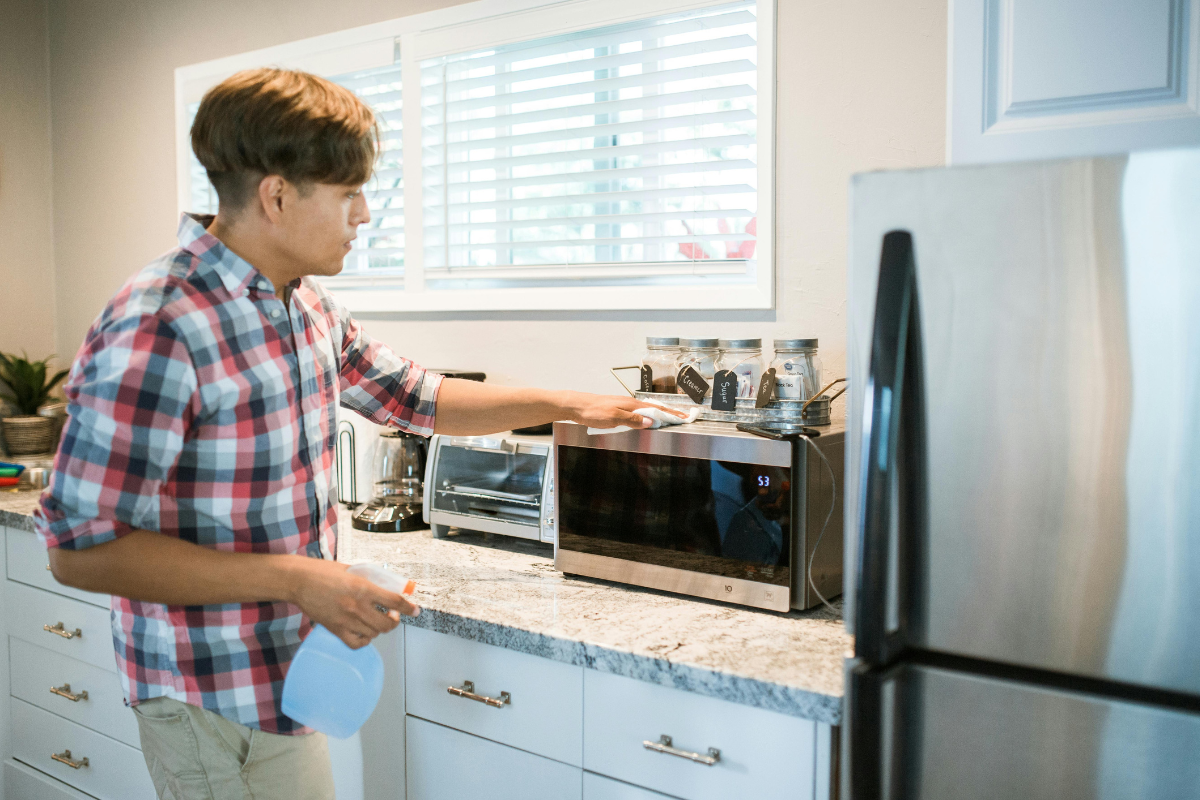
We often confuse two everyday actions: cleaning and disinfecting. In one case, you're trying to make a surface clean, visible and pleasant. In the other, you're aiming to eliminate potentially harmful micro-organisms.
Cleaning: removing dirt and maintaining surfaces
Cleaning means removing visible dirt and everyday residue: dust, grease marks, food stains or various deposits that build up on surfaces.
It's a mainly mechanical action, relying on scrubbing, water and the action of cleaning agents. Above all, it aims to restore a state of visible cleanliness and make the space healthier and more pleasant to live in.
Beyond appearance, cleaning also plays a maintenance role: it helps limit the build-up of grime on surfaces and reduces conditions favourable to the growth of micro-organisms.
The products used at this stage are detergent agents, including:
-
soap, which helps lift grease and dirt
-
the surfactants found in detergents and household products
-
multi-purpose cleaners formulated for different types of surfaces
These agents work mainly by helping to separate the dirt from the surface, so it can be removed during rinsing or wiping.
As you'll have gathered, the aim of cleaning isn't to eliminate bacteria or viruses, but to remove the impurities that can harbour, protect or encourage their growth over time.
Disinfecting: reducing the presence of micro-organisms
Disinfecting means greatly reducing, or even eliminating, the presence of micro-organisms (bacteria, viruses, fungi) on a given surface.
Unlike cleaning, this action relies on specific active substances, called disinfectants.
It's reserved for specific contexts, where the level of hygiene required is higher:
-
medical or paramedical environments
-
catering and food trades
-
particular health situations
-
the presence of a vulnerable person
Cleaning or disinfecting at home: do you really have to choose?
In everyday home use, the question isn't so much whether to choose between cleaning or disinfecting, but rather understanding in which cases each is really relevant. In most everyday situations, regular cleaning is enough to keep a healthy environment.
Many hygiene and environmental-health experts also point out that an over-sanitised home isn't neutral. Reasonable exposure to certain micro-organisms is part of our usual environment. Some bacteria are harmless, even useful, particularly for the balance of our microbiome and the development of the immune system.
The role of 'good germs' in our environment
Not all micro-organisms are problematic. A large proportion of them are even essential to the functioning of ecosystems and to our biological balance.
In soils, they take part in breaking down organic matter and recycling nutrients, which directly supports the fertility of farmland and plant growth. On the skin and in our bodies, they help form what's known as the microbiome. This microbial flora acts as a natural barrier, limiting the growth of certain pathogens and contributing to the body's overall balance.
From this perspective, systematically trying to eliminate all micro-organisms doesn't really make sense in a typical home setting. A completely sanitised environment is hard to achieve in reality and, above all, it isn't necessary for most everyday uses.
That's why a more nuanced approach is preferred: keeping a home clean, aired and well maintained, while avoiding the automatic use of disinfectant products when the situation doesn't call for it.
Why bleach doesn't really clean
Bleach is often seen as an 'all-in-one' product, able to both clean and sanitise. In reality, its action is much more targeted.
It works mainly as a disinfectant: it greatly reduces the presence of micro-organisms on a surface. However, it doesn't have the properties needed to lift everyday dirt.
Unlike a conventional cleaning product, it doesn't contain detergent agents able to dissolve grease, remove dust or lift ingrained stains. In other words, it doesn't act on visible dirt.
It can also be harsh on certain materials, textiles or finishes, depending on the conditions of use and concentrations.
Environmental impact
Depending on how it's used, bleach can generate chlorinated compounds that break down only with difficulty in treatment systems. Some of these residues can then end up in aquatic environments, with potential effects on ecosystems.
Impact on health
In a home setting, frequent, concentrated use, or use in poorly ventilated spaces, can cause irritation of the airways or eyes. Some studies have also highlighted links between regular use of chlorinated products and an increase in respiratory problems in children, without however establishing a single causal link.
Microbiological balance
Over-systematic disinfection can also alter the microbial balance of indoor environments. By greatly reducing all micro-organisms, it doesn't distinguish those that are potentially problematic from those that contribute to a natural balance of surfaces and living spaces.
The Danika view: back to basics
At Danika, the distinction between cleaning and disinfecting is above all about using the right approach rather than a systematic opposition.
The idea isn't to fill your cupboards with products, but to adapt the action to the real need of the moment. Not all everyday uses require the same level of intervention, and even less a systematic chemical response.
For routine cleaning, a properly formulated cleaning product is enough to keep a home clean and healthy. It removes dirt and naturally limits conditions favourable to the growth of micro-organisms, without constantly resorting to more powerful disinfectant solutions.
This approach also helps limit certain everyday excesses:
-
overconsumption of household products
-
repeated use of harsh formulas that aren't needed
-
the build-up of sometimes superfluous substances in the home environment
At heart, the philosophy is simple: a clean home doesn't need to be sterile to be healthy.
FAQ
What's the difference between cleaning and disinfecting?
Cleaning removes dirt; disinfecting reduces micro-organisms.
Is cleaning enough day to day?
Yes, in most cases, regular cleaning is sufficient.
When should you disinfect?
In case of illness, after risky contact or in sensitive areas.
Does bleach clean?
No, it disinfects but doesn't remove visible dirt.
Can you disinfect without cleaning?
No, a surface must first be clean for disinfection to be effective.
Best Sellers

Livraison gratuite dès 49€
Paiement sécurisé

Envoi rapide

Service client réactif